What Does a Book Editor Do? A Clear Guide for First-Time Authors
Understanding what a book editor does is one of the most important steps a first-time author can take before spending money on manuscript editing services.
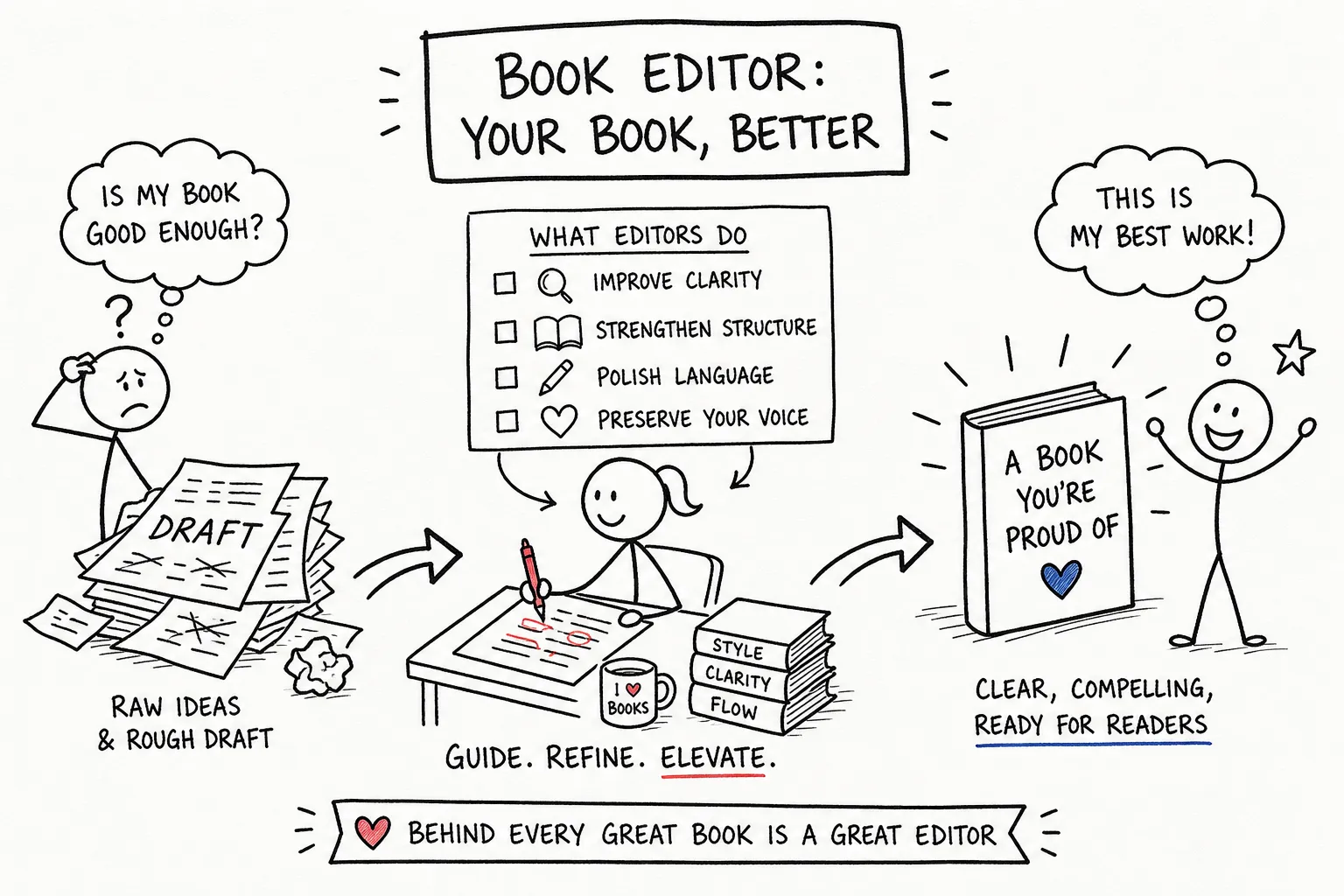
A book editor plays four distinct roles depending on where your manuscript sits: developmental editor, line editor, copyeditor, and proofreader. Each role solves a different problem, and hiring the wrong stage at the wrong time is one of the most common mistakes first-time authors make.
One concern authors raise is spending money on editing without knowing which type they actually needed. I regularly hear from authors who’ve already paid for line or copyediting and still don’t know whether their manuscript is ready to publish. They did not get a higher-level opinion: a manuscript assessment. Their manuscript is sitting on a structurally broken foundation, and no amount of polishing can fix that.
This guide covers all four editing stages, what each one delivers, what it costs in Australia, and how to find the right editor for your manuscript.
Key takeaways
- Four distinct stages: Developmental editing, line editing, copyediting, and proofreading each solve a different problem at a different point in the process. The Institute of Professional Editors (Australia) does not recognise line editing as a stage. My editing tends to focus on a line editing style but only if structure is okay.
- Order matters: Skipping straight to copyedit or proofreading when your manuscript needs structural work wastes money and produces a polished mess.
- Deliverables vary: Each stage produces specific files; always confirm in writing what you’re getting before you pay a deposit.
- Australian costs: Budget roughly A$2,500-$5,000 for developmental and line editing, and A$460-600 for proofreading a 40,000-word nonfiction book. Due to length and complexity, these rough budgets can be exceeded. Packages can offer a discount.
- Red flags are real: No written contract, vague scope, or any promise of guaranteed success are serious warning signs to walk away from.
What are the four stages of book editing?
Developmental editing: the essential first stage for most manuscripts
Developmental editing addresses the big picture: structure, argument, pacing, chapter order, and the overall coherence of your manuscript. The editor assesses whether your core idea lands clearly, whether your chapters build logically on each other, and whether the reader has enough context to follow your thinking. You receive an editorial letter, commonly around five to twenty pages, an annotated manuscript with margin comments, and a revision plan. For most nonfiction manuscripts, this is where the real book editor responsibilities begin.
Consider a business coach who comes with a completed manuscript on leadership, having already paid for a Fiverr person for proofreading or ‘editing’. The problem: her two strongest chapters are buried at the back and her reader has no context to understand them. No amount of proofreading can fix that. A developmental edit repositions those chapters, restructures the argument, and transforms the entire reading experience. This is the stage most authors skip, and the one that costs the most to skip.
One clarification: developmental editing does not correct every sentence. That work comes later, in the stages below. Think of it as architectural work, you wouldn’t tile the bathroom before confirming the floor plan.
Line editing, copyediting, and proofreading: the final three stages
Line editing works at the sentence and paragraph level. The editor improves clarity, rhythm, tone, and flow without changing what you say, only how you say it. Copyediting then handles technical correctness: grammar, punctuation, spelling, consistency, and compliance with a style guide. Your editor also creates a style sheet to track every naming and formatting decision across the manuscript.
Proofreading is the final stage and happens after typesetting. It catches remaining typos, page numbering problems, broken headers, and widows and orphans. It is not a substitute for any of the three stages above. Skipping straight to proofreading when your manuscript needs developmental work is like repainting a car that needs a new engine.
What does a book editor do at each stage, and what do you receive?
The files and documents you should receive at each stage
At the developmental stage, you receive a long editorial report, and if quoted for, an annotated manuscript with margin comments, and usually a follow-up call to discuss revision priorities. Line and copyediting produce a tracked-changes* Word file with comments, a clean accepted-changes version, and an updated style sheet. Proofreading delivers a marked PDF or typeset proof, a query list, and a corrections log.
* A tracked-changes file means you will see red pieces where your editor has suggested grammar changes; it does not mean the whole thing has been changed. If this happens, it suggests the whole thing has been run through an AI tool.
Always confirm in writing which deliverables are included before you pay a deposit. ‘Editing’ means different things to different providers.
Why a written brief protects both you and your editor
Before work begins, define the editing level, file format, number of review rounds, and whether a style sheet is included. Ask whether the named editor will perform the work, or whether it may be subcontracted to a trainee or staff member. Clarify what happens if the manuscript is longer or more complex than initially described. Scope creep is common, and fees can escalate without a written agreement to contain them.
What does book editing cost in Australia?
Typical fee ranges by editing stage
Australian editing fees vary with manuscript length, condition, and the editor’s experience. These manuscript editing services are priced differently depending on the stage and the complexity of the work. For a 40,000-word nonfiction manuscript, plan on approximately:
- Developmental editing: Roughly A$95-A$135 per 1,000 words, or A$1,600-A$2,900+ for the full manuscript. See below.
- Line editing and copyediting: Approximately A$70-A$120 per 1,000 words (A$910-A$3,500, depending on manuscript condition and length).
- Proofreading: About A$40-A$70 per 1,000 words (A$480-A$700 for a 40,000-word book).
Australian quotes may exclude 10% GST, so always confirm whether your estimate is GST-inclusive. Genre matters: a 60,000-word business book requiring a full developmental edit can realistically cost A$3,200-A$5,000 for that stage alone, before line editing begins. An AI-generated book may require more feedback at this higher level than usual but less mistake fixing.
Editor fees and turnaround times both vary significantly based on the editor’s schedule and the manuscript’s condition, so build buffer time into your publishing plan. Do not expect that the editor will be immediately ready to fit your work in, but if they are, allow time for their reading.
What changes your final editing quote
A clean, well-structured draft costs significantly less to edit than a raw first draft with major structural issues. Rush deadlines attract a premium, and nonfiction with citations, tables, or technical content takes longer than a straightforward business narrative.
Some editors bundle developmental editing and copyediting in a package, which can offer better value than booking each stage separately. Before committing to a full manuscript quote, perhaps request a sample edit on 1,000 words. This protects your budget and reveals whether the editor genuinely understands your voice and subject matter.
At Business Author Academy, we bundle manuscript assessment, copyediting and all design tasks, saving you a lot of time on quoting and missteps. The process has been honed over a dozen years helping authors, so new publishing packages does not mean new process.
How do you find an editor who’s right for your manuscript?
What to look for before you sign anything
Published credits in your genre or subject area carry more weight than a long list of credentials. Ask to see a before-and-after sample and an editorial letter, these reveal whether the editor can diagnose a manuscript and communicate their thinking clearly. Voice preservation is non-negotiable: a good editor makes your writing sharper, not theirs. For nonfiction specifically, genre expertise matters; an editor who specialises in memoirs may not understand the structural demands of a business book or how-to guide.
Australian authors should confirm whether the editor is familiar with Australian English conventions and whether they’re listed through the Institute of Professional Editors (IPEd), which maintains a searchable directory of accredited freelance editors. Accreditation isn’t the only measure of quality, but it signals professional standards and ongoing development.
Contract red flags every first-time author should know
Watch for these warning signs before you agree to services:
- No written contract, or vague verbal promises about scope or timeline.
- Promises of guaranteed bestseller status, traditional publishing deal or bookstore distribution.
- Any claim to copyright, royalties, or a share of future sales. Editors are normally paid per word, per hour, or per project; claims to royalties or ownership are a red flag unless explicitly agreed and documented (and there is no service fee). An editor byline on the inside cover does not entitle anything.
- A large upfront payment of all fees, with no refund or cancellation clause.
A standard payment structure is a 25, 50% deposit to secure the editor’s schedule, with the balance due on delivery. Anything significantly different to that warrants a clear written explanation before you commit.
Getting your manuscript into the right hands
Knowing what a book editor does, and when each type of editor fits into your process, is the difference between a manuscript that works and one that stalls. Developmental, line, copyediting, and proofreading each solve a different problem, and your manuscript needs them in the right order. Hiring the wrong stage, or skipping one, doesn’t save money. It creates rework.
Business Author Academy offers editing support from developmental feedback through to final proofreading, with a clear brief and defined deliverables at every stage. That depth of experience means your manuscript benefits from one consistent editorial voice, guiding it from first draft to publication-ready.
If you’re not sure which editing stage your manuscript needs right now, book a discovery call (blue button). Upon looking at half the manuscript, Jen will tell you exactly where it stands and what it needs next, so you invest in the right manuscript editing services at the right time.
Frequently asked questions about book editing
What does a book editor do, developmental editing versus copyediting?
A developmental editor works on the big-picture structure of your manuscript: argument, chapter order, pacing, and coherence. A copyeditor works on technical correctness at the sentence level, grammar, punctuation, spelling, and style consistency. These are different book editor responsibilities, and they happen at different stages. Doing them in the wrong order wastes money.
How long does each editing stage take?
Turnaround times vary by manuscript length and the editor’s current schedule. As a general guide, developmental editing for a 40,000, 60,000-word manuscript typically takes four to eight weeks. Line editing and copyediting may take two to six weeks. Proofreading is generally the fastest stage, often one to three weeks once the typeset file is ready. Always confirm expected turnaround in writing before signing a contract.
Do I need all four editing stages?
Not always. A manuscript that has already gone through multiple revision rounds with a book coach may not require a full developmental edit. However, most first-time nonfiction authors benefit from at least a developmental assessment before moving to line editing or copyediting. Skipping stages to save money often costs more in the long run when structural issues surface after publication.

Categories
Related Books or Services

Academics Book Planner: From Papers to Pages
Original price was: $11.00.$7.00Current price is: $7.00.