How I Turned My Book Into a Lead-Generation System
Like me, you may have already written a book and be wondering where those readers are…? You might also want to know how to turn visitors into buyers. This is how a method/insider story/creative how-to book is your calling card to new clients.
Despite what everyone reckons, Amazon and LSI/Ingram are not that good for your service business. Incidental passersby are unlikely to go straight to buy your book anyway, so your TikTok, Reels, Blogs, or Newsletter has probably convinced them to buy it. Why then are you giving over your new readers to a corporate behemoth in exchange for $2.50-$4 in most cases?
 Lightning Source International is a massive, global print-on-demand (POD) and distribution company owned by the Ingram Content Group . It is the publishing industry’s leading POD provider, operating a global digital library of millions of books and having printed over 99 million books.
____
In any case, I have been publishing how-to and aspirational books for years, and print-on-demand has never made more than $170 a year as a busy service provider. On the other hand, you can’t overstate what a great reputational step it is to hand a new acquaintance your book (on request) and point out some solutions to their problem/curiosity from it.
It was 2012 and I had just reformatted a printed guide as a book, Power Marketing – An Aussie Guide to Business Growth. I wrote about it on one of the blog posts done for our web design company. Well, blow me down if a new lead asked if I had written the book and asked to have a consultation (while having a look at it). That man instantly became a fan of the education, and a new client.
Rewriting my Path to New Clients
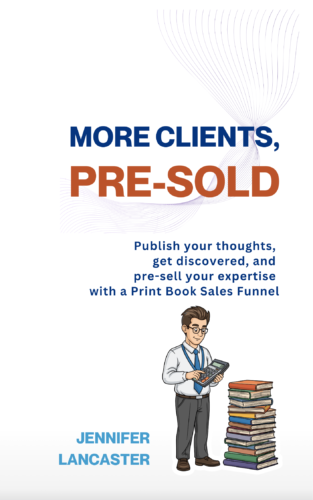
During the marketing of my book about being a micro publisher, it dawned that I was confusing people with the title… I also realised that my knowledge and experience was pointing towards a better system of ‘direct response sales’.
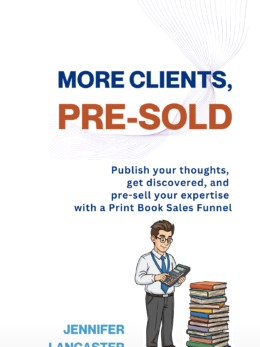
As I explain in ‘More Clients, Pre-Sold’:
We can now apply direct response copywriting principles to your book selling process, thus not needing to compete with millions of others in the great bazaar (Amazon). Direct response copywriting was the first marketing type that focused solely on experiments to test which version of an ad or letter worked the best. Readers’ Digest sold millions of copies through mailed letters, with psychological triggers embedded such as urgency and scarcity envelope copy.
Whereas marketplace selling does not allow for testing, selling books on our own website landing pages does allow a test, measure, adjust, and expand reach methodology.
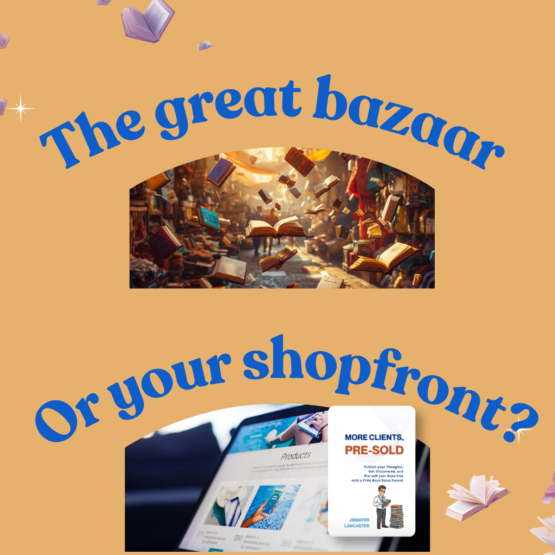
It dawned on me, some two decades into it, that I could utilise my direct response and email knowledge to create a book sales funnel. Then the choices were:
A
- Advertise & spruik a private landing page, featuring the book at a discount (the carrot)
- Automate an email welcome series for those buyers.
OR B
- Keep the sales pages as part of my ecommerce store and link to that in my online conversations.
- Forget to followup, but still have that email address for later newsletters.
With my newfound intelligence, I decided to opt for A) have a book landing page and automated email follow-up. They will also be exported to my newsletter, after the initial launch month.
In the meantime, there would have been four touchpoints:
1: the initial ad + message, event + message, or two direct messages.
3: the purchase and thank you note.
4: the informative (non-salesy) email.
Then it is a matter of keeping in touch until the right time for them dawns. It is a non-pushy approach, but I am also doing outreach for those wanting to move a bit faster. That is a lot harder to build trust.
Get your copy of More Clients, Pre-Sold right here in launch month.
Why You Need More than a Book Sales Page
Google reports have suggested that as a new brand you need a certain number of trust-building touchpoints, called 7-11-4.
- 7 Hours: The cumulative time a consumer spends researching and consuming your content (blogs, videos, podcasts).
- 11 Touchpoints: The number of unique interactions a user needs before buying, such as clicking an email newsletter, visiting a website, or watching a reel.
- 4 Platforms: The variety of locations where your brand is discovered and engaged with. [1, 2, 3]
With medium-sized books like mine averaging about a 11-hour read, it appears that it fulfils pre-purchase trust building. And if the book is written well, has unique and helpful pointers, and can be directly aligned to your service or membership offerings, then it only takes keeping in touch with further enlightening tips to become a real top-of-mind provider in this niche space.
A Real Life Example of Top of Mind
For instance, I read eloquent speaker Lindsay Adam’s book on the DNA of Business Relationships. Boy, will I never forget to listen carefully in every conversation and shaking hands while looking at the person. He will likely be my go-to if anyone mentions needing a speaker on communications. However, to continue the relationship, Lindsay could also have enquired whether I’d like to receive monthly tips on communications for business. I would say ‘yes’… I know no hype is going to come my way.
How does that get new clients?
At the bottom of every value-filled newsletter, you pop in a friendly call-to-action line:
If you’d like to achieve more readers, leads and clients and are curious how a book funnel system even works, for a limited time only I am gifting you a 45 minute consultation. Book here.

Categories
Related Books or Services
Academics Book Planner: From Papers to Pages
Original price was: $11.00.$7.00Current price is: $7.00.