
My Money Guide for Couples Earning $90,000 Annually
What does it mean to you as an income earner of around $90,000 to live well? (See this other guide for those making $60,000 a year).
Following a series, my money tips are designed to get you thinking about your money and potential paths to freedom. Everyone’s path to freedom is different – retirement; digital nomad; vlogger; investor – and will take the shape of their own vision.
Who am I to tell you what to do? I’ve spent a lot of time reading and thinking about how our money lives operate, within jobs or business. I’ve written some books on money and marketing and (unlike other authors) operated our household on a tight budget from time to time.
Income Does Not Reflect Lifestyle
In my philosophy of money, I encourage you to think about how you operate around income, saving, spending and lifestyle. Are you a saver – or a spender – or a savvy money personality?
This operating mode tends to rule what we do, rather than what we want to do. Some of it goes way back to how our parents operated their money… and just like other mantras, you picked up the money behaviour from that time.
Is $90,000 salary (less tax) enough as an Aussie couple for a comfy life?
In the cities, as a couple you probably think $65,000 is barely enough to afford rent & bills, let alone a mortgage & maintenance. But in fact, whether individual or couple, after tax you are in the top 89% richest in the world.
WHAT?
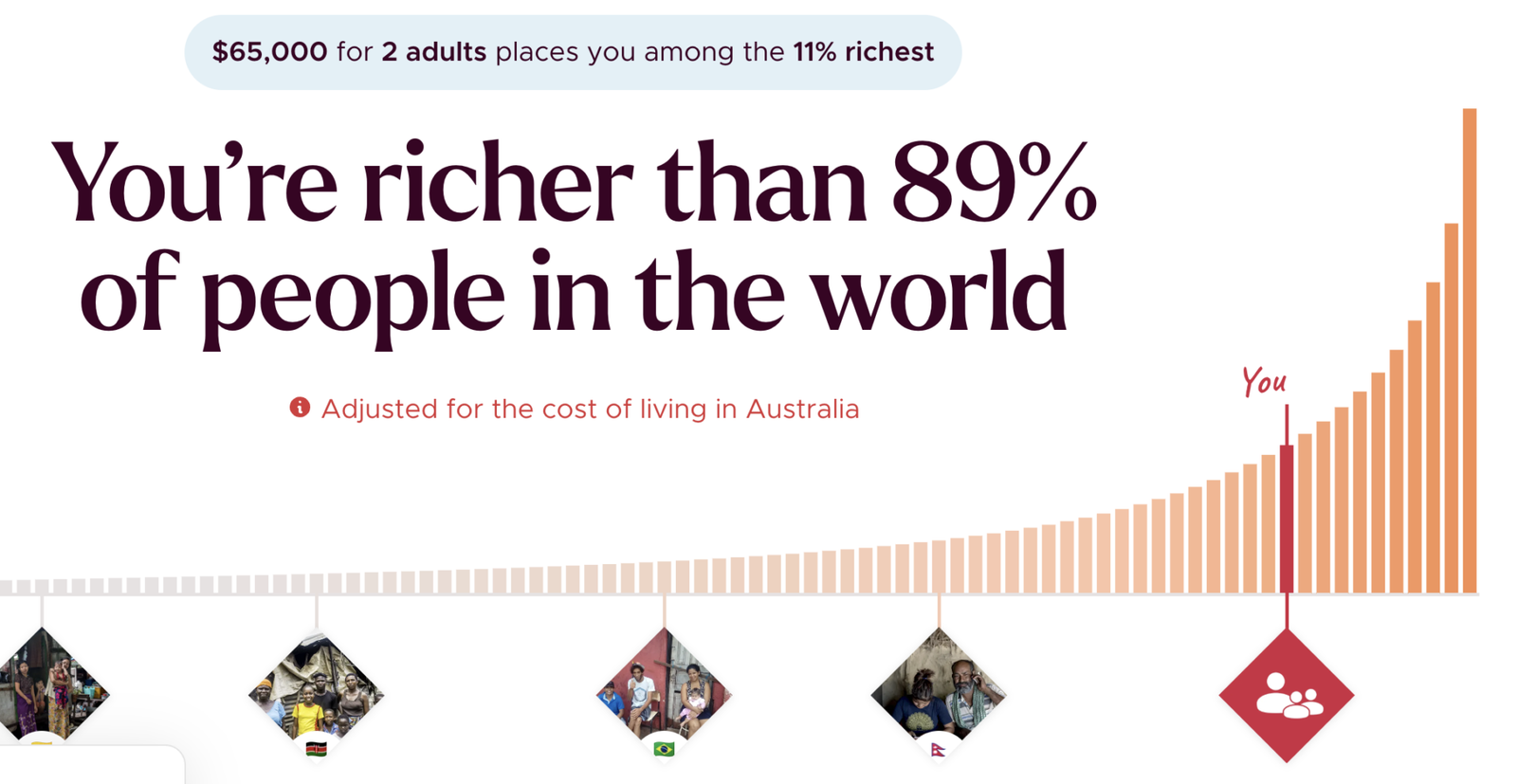
Source: https://howrichami.givingwhatwecan.org/how-rich-am-i?
(Also learn about Effective Giving there).
It really makes you think, doesn’t it.
Is this income being taken care of with a golden glove, or is some of it frittered away?
It’s a fact that the busier and more stressful our lives are, the more we are inclined to overlook spending.
And living in a relatively wealthy zone, we get trapped into thinking that all we need is more income to produce the lifestyle and future of our dreams. But, even if we get an increase in income (e.g., spouse goes back to work), this doesn’t fundamentally change how we live. Without a budget, we still spend haphazardly. We spend more, in fact. Most still give to charity or community about the same. We save about the same amount (unless a windfall comes all at once and a decision is made to save it).
This mental trap – that we have only just enough – seems to be in play at almost any income level above the poverty line. The outliers, cash millionaires, may feel comfortable, but that’s about it. This ‘comfort increase’ is the mind’s way of justifying more spending instead of putting the excess to better use.
If earning about $90,000 ($64 – 70,000 after tax) for a household per year, you are likely paying off your nice car, paying off your house or renting close-ish to the city, paying the bills and going to the odd restaurant dinner or lunch. But it’s not like you can go on three holidays or get the whole house renovated without worry.
You may feel hamstrung to this way of life, stagnant – and God help you if this job is gone or your business dives or someone gets very ill.
This is no way to live, top 89 percenters!
A bonus tip for a fun lifestyle is in holiday section below.
Money Guide for Those Earning < $90,000 per Year
Budgets are for You!
So, what’s the answer? Well, it’s as simple as a budget and a new line of thought. The budget will help you see where all the money goes to help prioritise to the most important areas. And the new paradigm will help you put aside some money, no matter how hard it is.
The good news is that simply by monitoring your spending over a four-week period, you will get to understand where your weaknesses lie. My weakness is for buying new clothes. I understand this, so I don’t receive email newsletters with sales on them. I don’t go to the big shops more than once every six weeks. The less you go, the more you save.
Most adults still in work can just make a list of things we need and get by with going to the shops for new pillows, new sheets or new jeans, for instance, about every six to eight weeks. (Those not in work may have to make do or look at second-hand places).
What about Saving for the Future?
If you want to save for the future, you’ll need to do a quarterly or yearly budget. Start by tracking most of your spending via your debit card statements (export the .CSV file for past 3 months). This is for both people, if a couple!
Also include credit card spending or hire purchase spending.
Or alternatively, use a money tracking app and really examine all the categories you spend on each month. Coffees and treats – what, $50! How did I do that?
Idea: WeMoney app – Budget, Money and Credit Score Tracker
- Track all financial accounts securely in one place (bank accounts, crypto, superannuation and your loans, i.e., repayments).
- Get reminders for upcoming bills and track subscriptions.
- Export your transactions.
- Opportunities to compare and save on financial products and utilities to see how you can potentially save and reduce your debt faster.
- View and monitor your credit score with the two biggest providers. Veda Advantage.
- Access to financial wellness community.
Getting to the Savings Part
Let’s assume that you are avoiding (or paying down) those high credit card interest and other credit options, so it’s time to look at saving part of what you are earning. Now I can hear your excuses already: “But I still have to fix my car, teeth, pay the school fees…”
Yeah, I know. But what if something life-threatening goes wrong? Could you pay for a major operation from your emergency funds? Or could you fly to be with the loved one interstate/abroad?
And homeowners, can you afford a new hot water system if the old one breaks? (Happened to us; $4,000 gobbled up and another $11,000 for termite damage repairs).
Buy Book below: https://link.amazon/B0hlyiDBU

Putting Highest Priorities in Place
We all realise that knowing our highest value priorities is crucial.
When you start prioritising, usually putting your family, your health and a stable home at the top, you may start to realise how you are living outside those priorities.
You might even realise that you’re sacrificing your health (e.g., costs of a physio) just to get a better car that you desire and enjoy (a lower priority). Perhaps eating lunch out daily and ordering takeaways means that you have nothing left over for an emergency fund, which, by its very nature, helps provide for high-value unexpected expenses.
A False Sense of Salary Security
Another thing to remember is to not think about a salary or revenue as that amount per year. You see, sometimes we get a false sense of security when we personally are ‘on’ or ‘making’ $90,000 a year. It seems a lot to begin with. Rather, we should be looking at the cash number received into the bank after taxes and business expenses.
Then, on our app or spreadsheet we should regularly examine our monthly fixed expenses. This is all bills, loans and must-haves, like the swimming or gym and the Speedos for the swim. (In case you’re wondering, Speedos swimmers save you money in the long run).
Pay Your Future First
One easy way to save your family’s highest priority, aside from your mortgage or credit account, is to put an automatic direct transfer of at least 5% of incoming salary into an emergency fund savings account. This goes on until it is built up to 3-4 months’ worth of regular expenses.
It’s non-negotiable to have this fund.
Family or Individual Holidays
After this, you might choose to put some family holiday money aside, if that’s a priority.
Firstly, I suggest thinking about your leftover budget when you plan the kind and duration of holiday to have. It’s no good jetting off on a 4- or 5-star, 12-day Noosa holiday and trying to pay it back later, as as this means you’ll be chasing your tail!
Instead, you could plan a holiday to South-East Asia, where every night, every activity and every dinner is half or less of what it is here. I booked six months ahead for The Philippines to get a deluxe room on Panglao Island (Bohol) for AU $33 per night ($269 for 8 nights). Cafe meals are about $5-7. Activities cost from $25-84. You can get a car and driver for AU $75 half day; $90 full day. (Best Inn is booked out for February but there are plenty more on Agoda. My prices were at VIP status).
If you find the budget has surplus after your emergency savings, then you can direct it to a voluntary Super contribution, either pre-tax with your employer or after tax, through a simple direct debit monthly contribution. It’s really easy – just ask your Super fund host.

Getting Clever with Daily Cash
Firstly, if you do have any kind of credit card, you should be very careful that you’re not using it for consumable items. Fair enough if your fridge and washing machine broke so you put both on Hire Purchase over three years – but don’t forget to work the repayments out yourself.
Always pay more than the minimum amount, so you will pay it out before gobsmacking interest rate kicks in. Yes, financiers do make ‘mistakes’ with minimum repayments.
How you get the surplus is by being smart with your spending every single day. Some examples:
- I replaced my Audible account with the free Libby app from my library.
- I started reviewing books authors gave me freely (an exchange of value)
- I use some affiliate marketing to earn income to pay for hosting
- Fresh fruit and vegies – only buy what we use in first four days, then return to the grocery store or market to top up potatoes, salad and bananas, tomatoes. Put any leftover pumpkin & capsicum into a Soup on Saturday.
- Use Aldi’s premium dishwasher tablets, which saves approx. $16 per 40 days! Don’t be fooled by those ridiculous ‘specials’ in the major supermarkets.
- I don’t buy container drinks while out – I carry a water bottle.
Getting Clever with Big Purchases
When you’re earning a bit more, it’s important to look at the big purchases! These most make a difference to our amount of background stress and worry.
- Ergo, do we really need a new car?
- Would it be better to save for an electric or hybrid car and not have to pay interest?
- Is a renovation going to increase my home’s value, or am I kidding myself as I really desire those flash new taps and bath?
- Is upgrading with the minimal new sink and tiles still a big improvement to the laundry?
When we go into debt to buy the best and newest of anything, we often put ourselves under more financial stress. Don’t assume that things will be easier money-wise in the future – consider instead that income might drop and you won’t want any more regular financial burdens. Or consider that you’ll do well but the money surplus is building up, taking your financial stress level down and helping keep the family safe.
Thanks for reading!
Know Your Finances SERIES on Kindle
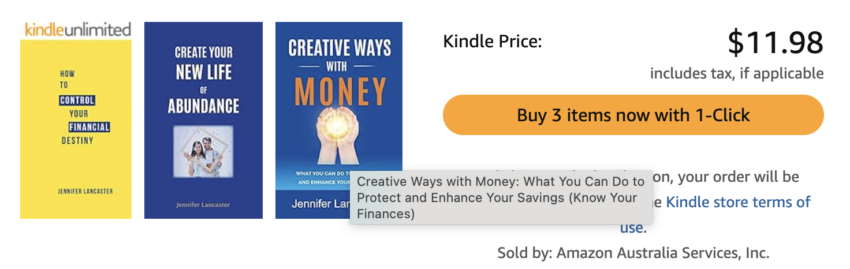
If you want to learn more about saving and investing, see How to Control your Financial Destiny. These links take you to Amazon to view. As an author-affiliate, we get 2% plus the Kindle rate.
Intermediate and want to invest? See Creative Ways with Money
Or if you’re interested in prosperity, then see 20 Most Asked Questions on Prosperity. Check iBooks, Kobo, or Amazon.

Categories
Related Books or Services

Academics Book Planner: From Papers to Pages
Original price was: $11.00.$7.00Current price is: $7.00.