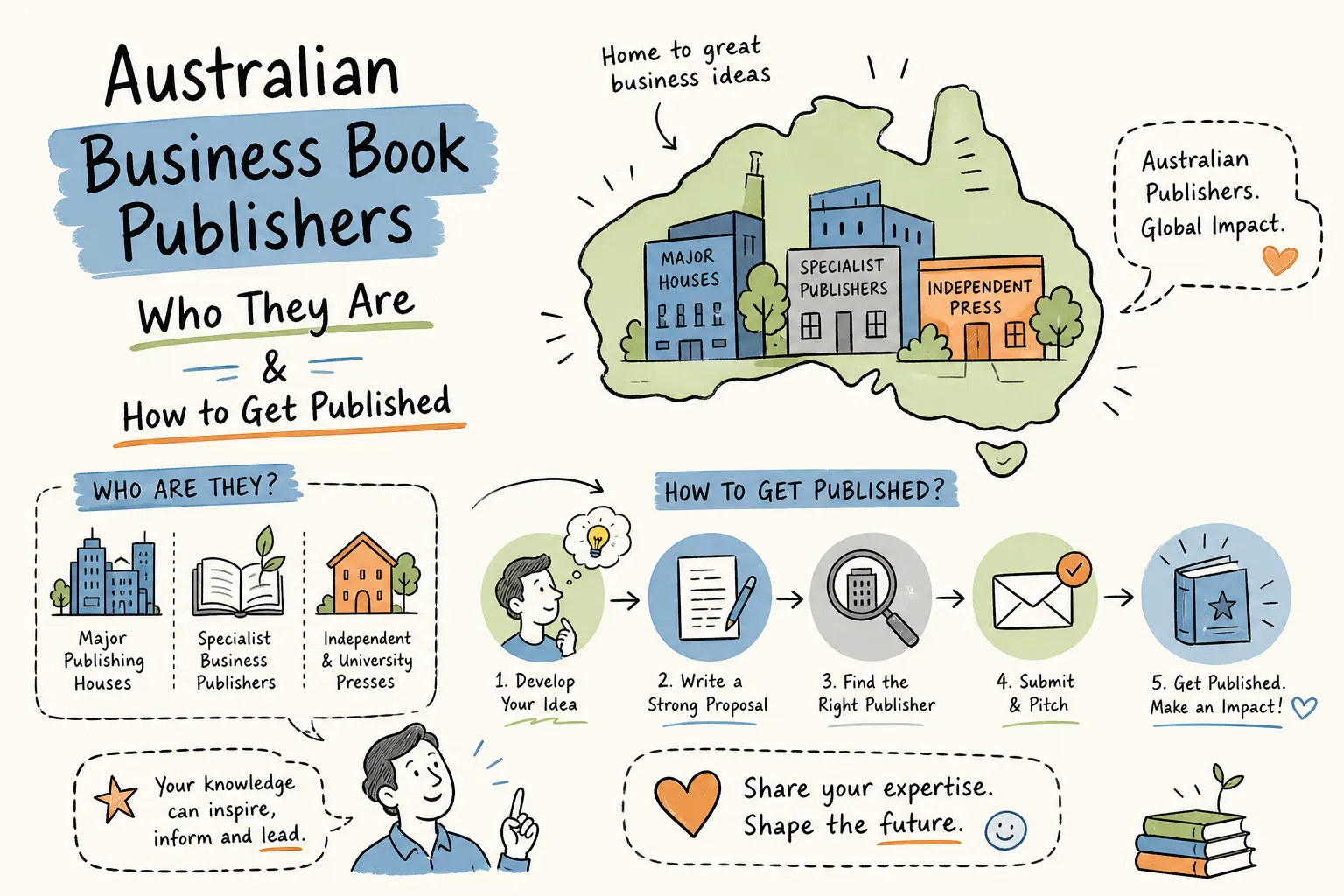
Australian Business Book Publishers: Who Are They and How Do You Get Published?
Sending a manuscript off and then waiting months for a response (mostly to hear ‘no’) is never what business authors want to experience. Even though it would be nice to feature your books in the airport–a la Simon & Schuster–the publishing submission process is a test of one’s patience.
In my experience, most proposals to Australian business book publishers fail not because the idea is weak, but because the proposal doesn’t come across as commercially sound.
Now, at this stage they may have a common question: “Where do I even start with finding good publishers or supporters in Australia?”
But… The publishing market is broader than most people expect, and your options range from large trade to small presses to credible hybrid publishers (a paid service) with genuine editorial standards. This article maps out who’s actually publishing business nonfiction in Australia, what a submission package needs to include, the honest trade-offs between traditional and self-publishing, and how to choose the path that fits your goals as a business author, including how to publish a business book in Australia when you decide the time is right.
Australian business book publishers: the full picture
Trade publishers with a dedicated business list
A strong specialist option for Australian business authors is Major Street Publishing, which focuses on business, finance, leadership and professional development titles and accepts submissions year-round. Allen & Unwin publishes broad business and professional nonfiction and accepts open submissions through its Friday Pitch process, requiring a cover letter, synopsis and approximately 60 pages or two to three sample chapters.
Pan Macmillan Australia accepts nonfiction proposals alongside a 50-page sample, but only opens its submission window twice a year, in March and September, and authors must be Australian or New Zealand residents. Hachette Australia and Big Sky Publishing each publish practical business and professional nonfiction within broader commercial lists, making both worth shortlisting depending on your angle and subject matter.
Hybrid Publishers, based in Melbourne, Australia, publishes high-quality books covering a broad range of titles by well-known and new authors, including business and legal texts, history, memoirs, Judaica, books on personal development and health, etc. If applying, note that you are likely to be shepherded towards their partnership (50:50 joint venture) model, where they jointly cover the costs. Fontaine work in a similar fashion; the team are focused on commercial work.
An important note: submission windows and policies change regularly. Always confirm a publisher’s current guidelines directly before you send anything, because submitting outside an open window is a reliable way to have your submission dismissed without review.

If that path didn’t work…. Disappointed and somewhat confused about what makes a commercial book proposition, the non-fiction author jumps online and seeks a supporter for self-publishing to provide their experience and support. Welcome, welcome, you are here.
Hybrid publishers for authors who want more control
Between traditional publishing and full self-publishing sits a growing tier of Australian hybrid publishers. Companies such as Business Author Academy (Brisbane), Clark & Mackay (Brisbane), Good Prose Studios Press (Coledale, NSW) and Peony Publishing operate in the assisted-publishing space. Although fees, inclusions and royalty structures vary considerably between them.
Business Author Academy (my brand) offers two packages, with visual book graphics and editing support baked in. Reasonable brand-you website design is a new part of the offer. Printing and POD choice is up to the client, and author copies are a reasonable price – always dependent on colour and length.
Clark & Mackay is a printer and offers tiered packages, while Good Prose Studios Press structures its offering around entry-level and premium service tiers. Examples of hybrid publishing packages range from $1,000 to $25,000 or more depending on the scope of services included.
These are legitimate options for many business authors, but before signing anything, verify what editorial services are actually included, who owns the ISBN, and exactly how royalties are calculated and what deductions apply.
Editorial is where the bulk of the time on a project goes, in my experience. Then design work, and third administration. If editing is not included, one must ask: why so high a price then? And why $10,000 for group author coaching and book production but skating through the whole commerciality angle?
How Australian business book publishers assess proposals
The proposal package publishers expect
A standard submission to an Australian trade publisher for a business nonfiction title typically includes:
- A cover letter with your title, category, word count and a sharp one-paragraph elevator pitch
- A synopsis of up to 250 words
- An author biography that emphasises credentials and platform
- Comparable titles to show market awareness
- A detailed chapter outline
- A sample of 50 to 60 pages
That chapter outline is almost always expected for nonfiction, publishers including Hachette, Pan Macmillan and Hybrid Publishers specifically request it in their guidelines. A polished concept alone is not enough; publishers need to see that your idea can sustain a full book and that every chapter advances the reader toward a promised outcome.
Platform and market case: what tips a submission over the line
A life coach came to me after receiving rejections from publishers she’d approached directly. Her idea was pretty good and her writing was solid, but her proposal made no mention of her audience size, speaking engagements, or how her book connected to a specific and demonstrable demand in the market.
Once we repositioned the proposal around commercial demand and her existing reach, it gave the manuscript a better chance to be selected. (I am not privy to what happened).
Publishers are not just buying a manuscript. They are investing in your ability to sell the book. Your platform, your business reach and your niche credibility are part of the submission package, and a proposal that doesn’t address them will struggle regardless of how strong the content is. Quantify your audience wherever you can: email list size, social following, speaking bookings, corporate clients, and any media appearances all belong in your author biography section.
Traditional publishing vs self-publishing: the honest trade-offs
Where traditional publishing has a genuine edge
Being accepted by a trade publisher carries a credibility signal that self-publishing can’t fully replicate, particularly for speaking engagements and corporate positioning. Major publishers also bring established retail distribution, library networks and, in the case of publishers like Hachette and Penguin Random House, international rights support through their global networks. Advances for business nonfiction in Australia are often modest; the Australian Society of Authors has reported that around 80 per cent of surveyed authors received less than $5,000, with approximately 58 per cent receiving no advance at all. Fiction makes up the vast majority. Even when giving small advances, the publisher carries the production risk and many titles don’t make a profit.
Why many business authors choose self-publishing instead
Speed is the most immediate advantage of assisted self-publishing: traditional publishing timelines typically run 15 to 24 months from submission to bookshop shelves, while self-publishing can get your book in front of readers within three to six months.
Royalty rates tell a similar story. Traditional print royalties on business nonfiction commonly sit at around 10 per cent of the recommended retail price (excluding GST), with ebook royalties often closer to 25 per cent of net receipts. By contrast, self-publishing through Amazon KDP can return up to 70 per cent on ebook sales within eligible price bands, though rates vary by territory. Many qualified authors are also rejected because the market timing or publisher fit isn’t right; they may have too many of that category already.
For a business author whose primary goal is lead generation and client attraction, self-publishing is frequently the faster, more controllable path. Aligned Clients is my newsletter on LinkedIn, free to read.
Choosing the path that suits your goals as a business author
Before you approach a single publisher or set up an Amazon KDP account, work through these three questions.
Start with your goal: is it credibility or lead generation? Traditional publishing serves the credibility goal well, particularly if speaking gigs and corporate clients are central to your work. Self-publishing, paired with a book funnel and digital launch strategy, serves the lead-generation and client-attraction goal directly and more quickly.
Then be honest about your online platform. Do you have a large audience a publisher can see? If not, self-publishing now while building your audience is often the smarter first move. Just be sure to get started on the building right away!
Finally, look at your timeline. If you want the book actively supporting your newish business within the next 12 months, a 15 to 24-month traditional publishing process is unlikely to serve you.
Getting submission-ready if you decide to pursue a publisher
For authors who decide the traditional route is the right fit, the quality of the publisher proposal is the difference between a response and a rejection.
In my work, I would like to offer self-publisher launch assistance: a service designed to help Australian business authors commercialise their book and align it to services. This may include reviewing how the proposed manuscript makes a strong market case, how it relates to your first-offer and second-offer, what are comparable titles and how does this book fill a strong gap. Whether you use it for traditional or for self-publishing, it makes a commercial case, just like in our business book writing guide.
This sits alongside Business Author Academy’s full suite of 1-to-1 coaching, comprehensive editing and self-publishing support, so whether you decide to pursue a trade publisher or take the self-publishing path, you have experienced guidance in either direction.
Your next step
Many Australian business book publishers do accept unsolicited submissions, though the procedures and open windows vary by house. Allen & Unwin’s Friday Pitch process, for example, is open year-round, while Pan Macmillan’s submission windows run in March and September.
Publishable is a manuscript development grant operated by Queensland Writers Centre, apply from April to June. Always check individual guidelines before you submit. What remains consistent across the board is this: the submission needs to be treated as seriously as any business pitch, with the same attention to audience, positioning and commercial argument that you’d bring to a client proposal. Whether you pursue a trade publisher or choose to self-publish, the book still needs to be positioned around your authority, your audience and your business goals.
When you’re ready to take the next step, reach out to book a needs call and we’ll discuss which path might fit your book and your business.

Categories
Related Books or Services

Academics Book Planner: From Papers to Pages
Original price was: $11.00.$7.00Current price is: $7.00.