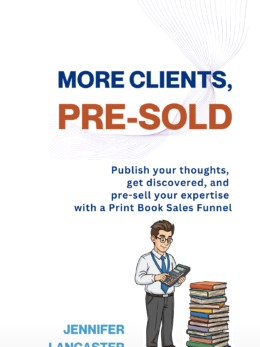
You Don’t Need an Ad Budget to Sell Books — You Need an Easy Promoting System
There are only 20 copies of More Clients, Pre-Sold left! Before they’re gone, here’s a look inside Chapter 11: Marketing Secrets and Optimisation. Specifically, the organic traffic playbook that costs nothing to run except your time. You need an easy promoting system designed specifically for books.
Why Organic Traffic is Different From Paid
The obvious appeal of organic traffic is that you’re not paying for every click. Beyond your website’s design and hosting, the visitors who find you through a blog post, a LinkedIn comment, or a Pinterest pin cost you nothing to acquire.
But the real advantage isn’t the free traffic itself – it’s what you can do with it afterwards. Once someone lands on your hosted book page, you can do Facebook ads, but only remarketing to them. That’s a visitor who visited your site, showed interest, and can now be brought back with a targeted ad, an email sequence, or a launch announcement for your next title. Cold paid traffic gets you a stranger.
Organic traffic, done right, gets you a name on a list you own.

As I put it in the book:
Returning traffic is a boon for authors. Email lists built over time can help with increasing return numbers.” (p. 80)
That’s the whole game. Every channel below is really just a different door into the same room — your list, your reader relationships, your next sale.
The Channels to Build Community – Chapter 11
Blog / Substack. Your home base. This is where organic traffic from every other channel should eventually land, because it’s the one platform you fully control and can capture emails from.
LinkedIn. Useful for nonfiction authors positioning themselves as an authority, particularly business, career, or self-improvement titles. Start a newsletter.
Instagram. Visual hooks with yourself and book, quote graphics, behind-the-scenes content. Better for building recognition and community than for direct conversions, but may be valuable for staying present with readers over time. Optional.
Facebook. Still strong for community-building through groups, especially for authors with a niche readership who want ongoing discussion, not just one-off sales.
YouTube. Long-form or short-form video content that can rank in search for years after you publish it — one of the few organic channels with genuine compounding return. Don’t just get a trailer made. Instead, set up a channel with full details on your background, why you wrote this, next in series or next digital product, and link to blog.
ChatGPT and other AI chat tools. An emerging discovery channel. As more readers ask AI tools for book recommendations, having a clear, well-described presence online increases the odds your book gets surfaced in those answers. This relies on giving and seeding your book with PR stories and book influencers.
Pinterest. Underused by most authors, but somewhat effective for visually-driven genres and for driving long-tail traffic to blog content months or years after a pin is created. Ensure picture relates to the web page content.
The Lesser-Known Methods
Chapter 11 also details a handful of organic tactics that get skipped by authors chasing follower counts:
- Book listings across retailer sites — checking and tightening your description quality on every platform your book appears, not just the one you focus on
- Reviews via niche bloggers and BookTok creators — smaller, engaged audiences often convert better than broad influencer reach
- Guest articles at online magazines — with an authorised link back to your book, these build both credibility and backlinks
- Reader giveaways — a low-cost way to generate reviews, word of mouth, and early list growth
Build a Group, Not Just a Following
The chapter also covers community building and social listening — actively watching what your readers are saying, where they’re saying it, and using that to shape your content plan. This is how you go from “an author with some followers” to having a group of your own that you can talk to directly, launch to directly, and sell to directly.
Before You Launch
Chapter 11 closes with guidance on building your inner circle pre-launch: who to bring in early, how to ask for their help without it feeling transactional, and why approaching the whole process with a grateful viewpoint tends to produce better results than a purely tactical one.
The Point of All of This
None of these channels matter in isolation. A blog post, a LinkedIn comment, a Pinterest pin — they’re only worth the effort if they lead somewhere. Every organic method in Chapter 11 is designed to move a stranger into your orbit, onto your list, and into a relationship where a $19 book is the beginning of the conversation, not the end of it. That’s where the workshops, the programmes, and the next book pre-sales come from.
_________
There are 20 copies of More Clients, Pre-Sold left at $19. If you’re building an author or publisher business rather than chasing a single sale, this is where the system is laid out in full. Australian postage, paperback, 154 pages, 6″ x 9″.

Categories
Related Books or Services
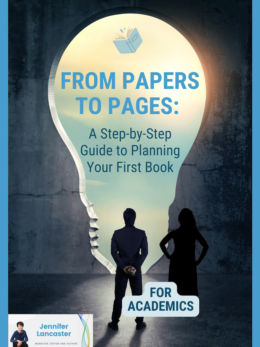
Academics Book Planner: From Papers to Pages
Original price was: $11.00.$7.00Current price is: $7.00.