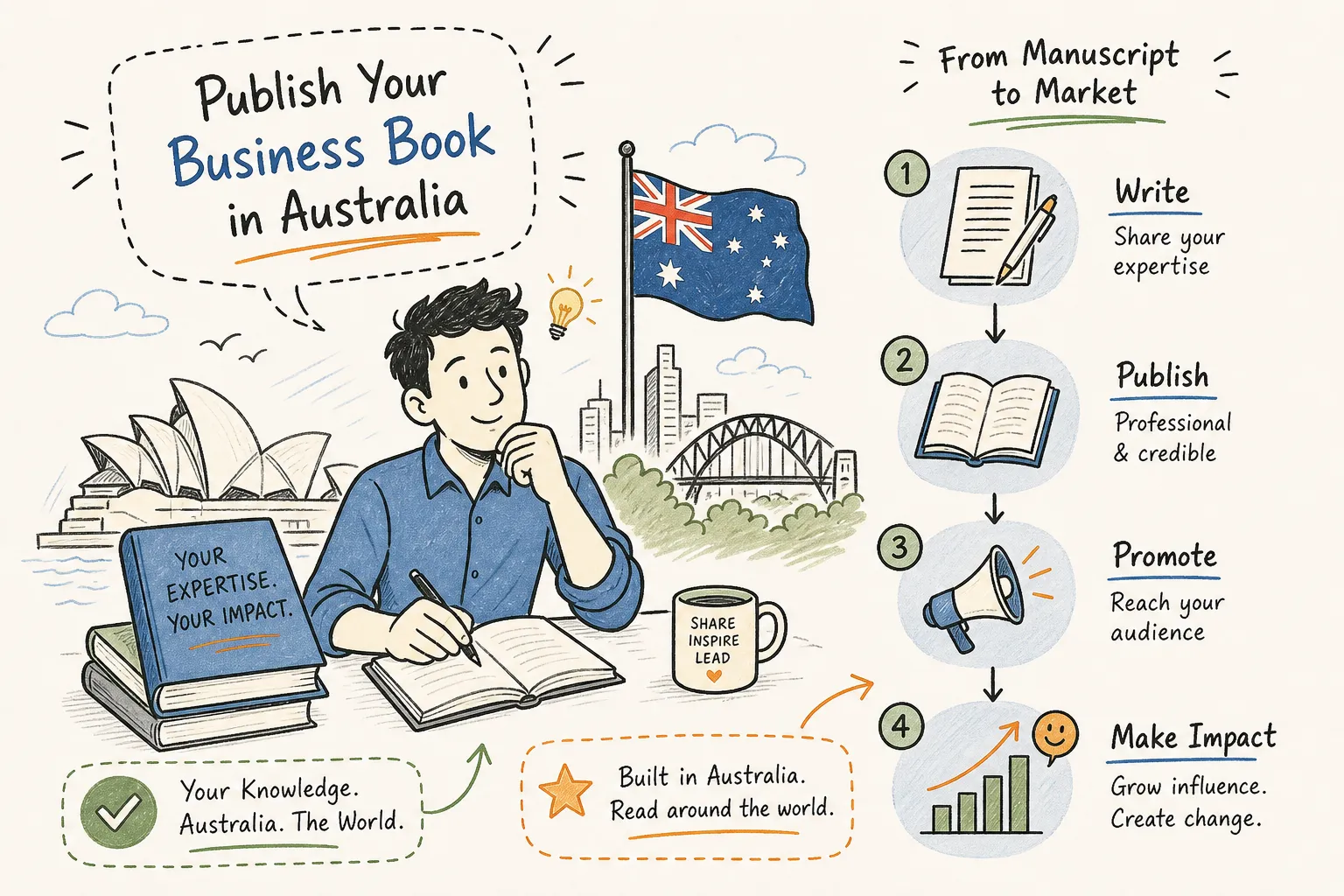
Business Book Publishing in Australia: Your Complete Guide
Business book publishing in Australia offers three main routes: traditional publishing, hybrid publishing, and self-publishing. Each involves different trade-offs on cost, control, timeline, and the level of support you receive.
Traditional publishing suits authors with a strong public platform and a concept with mainstream appeal; hybrid publishing suits those who want structured production support and are willing to share the investment; self-publishing gives you full control, a faster path to market, and maximum long-term royalties.
The worthy fear most first-time authors carry into this decision: the worry of investing money into the wrong route, ending up with a book that doesn’t represent them professionally, or signing with a service that retains their ISBN and leaves them with almost nothing after deductions. That fear is not unfounded.
The Australian publishing market includes genuinely excellent partners but also some services that profit far more from authors than they ever offer them.
Business Author Academy works with coaches, consultants, and business professionals who arrive at this crossroads with an urgent need to understand their options before committing. This guide gives you what those authors needed before they chose: a clear comparison of routes, a realistic look at costs and timelines, and the Australian-specific requirements that most publishing guides overlook.
Business Book Publishing Australia: Which Route Suits You?
Traditional publishing: credibility that comes at a cost
Traditional publishing means a commercial publisher acquires the manuscript, funds production and distribution, and retains significant editorial control. There is no upfront cost to the author, but print royalties are typically in the low-to-mid teens of the recommended retail price depending on contract terms, and the author has little say over cover design or release timing. The submission process is highly competitive. Publishers such as Major Street Publishing, Allen and Unwin, and Pan Macmillan Australia are selective: they want authors with an established platform, a distinctive thesis, and demonstrable market reach. For most coaches and consultants, traditional publishing is a long shot without a literary agent or a substantial public profile.
Platform building and commercial nous is not an art that comes easily to most authors, and the lowest-cost way to learn is through reading.
A book I own and continually recommend: (Amazon Associates link)
Hybrid publishing: structured support with a shared investment of time
Hybrid publishing means the author contributes financially to production but retains far more control and a higher royalty share than in a traditional deal. The spectrum in Australia is wide, from light production-assistance services through to full editorial and marketing support packages. Quality varies significantly. Some hybrid services register the ISBN in their own business name, which limits the author’s long-term control over the book. Before signing anything, verify copyright retention, ISBN ownership, and the scope of editorial work included; these three points separate a genuine publishing partner from a service that benefits primarily from the author’s upfront fee.
Self-publishing a business book in Australia: maximum control, fastest route to market
Self-publishing means the author manages every element, either personally or by commissioning specialists. You retain full copyright, own your ISBN, and keep the majority of net royalties. The work involved is substantial, and the most common mistake is underinvesting in editing, mentoring and design to save money, then launching a book that undermines rather than builds professional credibility. It is putting it on marketplaces without a promotion plan.
For a business author, the book is a lead-generation and authority-building asset, it needs to reflect your expertise at the highest level.
Criterion | Traditional | Hybrid | Self-publishing |
Timeline to market | 12–24 months | Varies; often several months to a year | 3–6 months |
Royalty or return per sale | Low-to-mid teens of RRP (contract dependent) | Higher than traditional; varies by contract | Majority of net receipts |
Author control | Low | Moderate to high | Full |
Distribution reach | Wide, including bookstores | Moderate; varies by provider | Wide via KDP and IngramSpark |
Australian Publishers That Accept Business Books
Specialist presses vs. large trade houses: knowing where you fit
Specialist presses such as Major Street Publishing and Ventura Press focus primarily on practical, expert-led nonfiction and represent the strongest initial target for coaches, consultants, and professional-services authors. Large trade houses prefer authors with mainstream appeal, significant media profiles, or a concept with broader appeal. Black Inc. suits authors writing at the intersection of business, economics, and public affairs. Big Sky Publishing and Vivid Publishing are worth considering for niche professional audiences or corporate publishing needs.
What a submission package actually needs to include
Australian trade publishers typically assess a book proposal rather than a completed manuscript. A standard proposal includes a covering letter, synopsis, target audience and market positioning, comparable titles, author biography, platform evidence, sample chapters, and manuscript status. For a business book specifically, the proposal must also articulate the problem the book solves, the reader’s practical outcome, and how you will actively contribute to selling it. Submission windows matter: Scribe accepts proposals only during specified three-week periods, while Pan Macmillan requests a 50-page sample. Submitting to a mismatched publisher is one of the most avoidable mistakes a first-time author makes.
Business Book Publishing Australia: Costs & Timelines
Breaking down the self-publishing budget
Production components typically break down as follows:
- ISBN registration (Thorpe-Bowker): A$44 for one or A$88 for ten, plus a one-time A$55 new-publisher setup fee for first-time purchasers
- Print proof and delivery (budget around $35)
- Cover design – from $130 for apprentice; $360 for master. AI covers are not recommended, especially for print books.
- Proofreading – for those who edit their own book and are in the writing trade. Expect around $2 per print page, e.g., $400 – $550 per book.
Print-on-demand through Amazon KDP carries no upfront investment but rather a per-copy production cost – according to page count and trim size. It has streamlined logistics and so delivery is incredibly reasonable.
IngramSpark provides high quality printing but charges high freight for singles, handling of $2, and GST on top of all that means most orders for my 150-page books are from $160 – $180 (20). You get bulk print discounts.
Hybrid publishing investment ranges in Australia
Business Author Academy provides packages that cover editorial, design, and marketing as an integrated service — or tailored quotes for one of those. Supporting individuals, and as a sole trader who runs on talent, skills, and creative energy, you are getting the most bang for your buck. Packages like Self-Publish and Own it start at $4,500 for a shorter book to $7,000 for one with lots of internal work and 50,000-word length.
Compare, but this support is not the same as the omnipresent publishing support companies, as they don’t care if your blurb is written well or your book title and hook is positioned correctly for attracting clients.
Where to put your money first
Invest in editing before anything else, then cover and interior design, then targeted launch marketing. Print large quantities only after you have tested demand or have confirmed bulk buyers, corporate orders, or events lined up. A poorly edited book damages authority in a way no amount of marketing can repair. Whereas, a well-edited, professionally designed book can generate referrals and leads steadily for years through a practitioner’s network alone.
How Long Does It Take from Manuscript to Market in Australia?
The traditional publishing timeline
Plan for 12 to 24 months from contract signing to publication, with 18 months a realistic midpoint for an Australian business book. The stages move in sequence:
- Editorial briefing and schedule: 1–3 months
- Structural editing and revisions: 2–6 months
- Copy-editing and proofreading: 1–2 months
- Cover design and typesetting: 2–4 months
- Printing, distribution, and retailer lead time: 2–4 months
Marketing typically begins several months before release. Illustrated or colour-heavy books printed offshore can add a further three months to the production schedule.
The self-publishing timeline: realistic vs. optimistic
A finished manuscript can reach market in three to six months through self-publishing, with six months being the sensible target for a professionally produced business book. The key stages are:
- Editorial work: 4–10 weeks. A Manuscript Assessment may only take 10 days but lead time adds on.
- Copy-editing and proofreading: 2–6 weeks
- Cover and interior design: 3–8 weeks
- ISBN and distribution setup: 1–3 weeks
- Proof review and launch preparation: 2–4 weeks
A one-to-three-month timeline is technically possible but is rarely advisable for a credibility-building book. If speed to market is the priority and business ROI matters more than bookstore placement, self-publishing is the stronger choice.
Australian Publishing Requirements Every Business Author Needs to Know
Registering your ISBN and what it controls
Australian ISBNs are issued through Thorpe-Bowker. Each format (print, ebook, audiobook) requires a separate ISBN. The registered owner of the ISBN is recorded as the publisher of record: if an assisted service registers the ISBN in their business name, you are not the publisher and may face complications if you later want to move distributor or republish the work. Unless you want to get one with real distributor links, register your own ISBNs.
Legal deposit, copyright, and contract rights
Legal deposit requires that a copy of every published work be deposited with the National Library of Australia within one month of publication, with additional copies required by the relevant state or territory library.
Copyright in Australia arises automatically at the moment a work is created in original form; no registration is required. In many traditional deals, publishers are granted specified rights, often as a licence rather than a full assignment of copyright, which is less common and should be checked carefully in any contract. In self-publishing, you normally retain your rights unless you sign them away.
Watch for these contract red flags: indefinite rights assignments, net-receipts royalty calculations that dramatically reduce actual earnings, clauses restricting you from publishing related content elsewhere, and any arrangement where a fee-based service also holds exclusive worldwide rights to your work.
Key takeaways
- Know the three routes: Traditional publishing offers credibility and no upfront cost but limited control and long timelines (typically 12–24 months); hybrid publishing shares costs and control, but quality and contracts vary; self-publishing gives fastest time-to-market and full control (usually 3–6 months from a finished manuscript).
- Own your ISBN: Register your ISBN through Thorpe-Bowker in your own name before working with a publisher or service — the registered owner is legally the publisher of record.
- Invest in editorial first: A poorly edited book damages authority. Prioritise professional editing before design or marketing to protect your reputation.
- Watch for vanity traps: Before signing with any hybrid or assisted-publishing service, verify copyright retention, who owns the ISBN, and how royalties are calculated.
How to Choose the Right Publishing Support for Your Book
What separates a trustworthy publishing partner from a vanity trap?
A typical scenario we see: a novice author arrives having already signed with a service that promised a “fully supported” publishing experience. The arrangement produced minimal editorial input, an ISBN registered in the service’s name, and royalties reduced to almost nothing after deductions. This kind of outcome is more common than it should be.
The criteria that separate a genuine publishing partner from a vanity publisher are about control: you retain copyright; the ISBN is registered to you; editorial scope is clearly defined in writing; royalty calculations are based on gross receipts, not net; and the service earns revenue from fees or from sales, but not through an opaque arrangement that conflates both. When you approach publishing as a business asset rather than a creative project, every clause in the contract has a commercial consequence worth understanding.
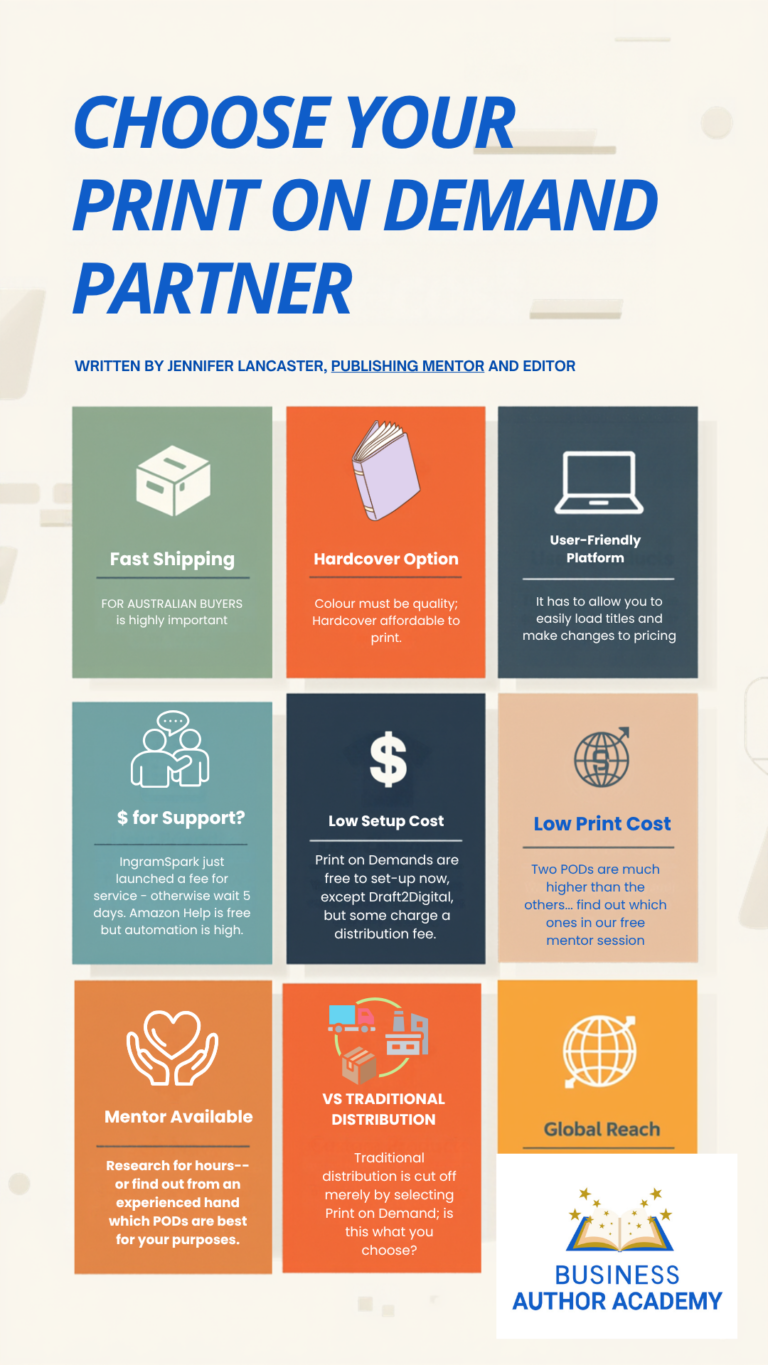
Print-on-Demand platforms like KDP, IngramSpark, Lulu and Bookvault has meant that fresh-faced authors think they are going to be the way you sell your books. As I say in ‘More Clients, Pre-Sold’…. Amazon KDP and the like are not the gold you wish for, they only provide the handle. You have to find the nuggets yourself and dig them up.
You find the customers, you create the ‘genuine person, not phony’ vibe, and they merely sell and ship each book from the closest printer location.
Why Business Author Academy takes a different approach
At Business Author Academy, we combine editorial expertise with a marketing-minded framework, which means every decision, from the book’s structure and chapter hooks through to the launch sequence and Amazon A+ content, is made with your business goals in mind, not merely the quality of the manuscript on its own.
The support available spans one-to-one coaching, developmental and copy-editing, self-publishing guidance, design, marketing templates, and launch support, at multiple investment levels, support for every stage.
Jennifer Lancaster has edited more than 34 nonfiction books. Now focusing on specialists, our advice is about aligning the book with your brand and services. This is so it functions as a lead-generation and authority-building tool from day one. Book a Needs and Options call to identify the right support plan for your book and your business goals.
Your Next Step as an Australian Business Author!
The route you choose for business book publishing in Australia matters less than the fundamentals you bring to it. Traditional publishing suits authors with a strong public platform and a mainstream concept who can plan for an 18-to-24-month timeline. Hybrid publishing suits those who want structured production support and are prepared to invest. Self-publishing suits those who want control, speed, and maximum long-term returns. Whichever path you take: own your ISBN, understand legal deposit, and read every contract clause on rights and royalties before signing anything.
 If you are a coach or consultant in Australia ready to use a book to build your authority and attract better clients, the next step is getting clarity on which route aligns with your timeline, budget, and business goals. Jen at Business Author Academy exists to give you that clarity, and to walk with you through every step of the process from that first conversation through to launch day. Get in touch to start the conversation.
Frequently Asked Questions
If we use a hybrid publisher, can we keep the copyright to our book?
You can keep rights to your work if the hybrid contract explicitly permits it; verify this before signing. Remember, copyright belongs to you on authoring, but rights to publish are something else. Check the agreement for any indefinite assignments or clauses that restrict your ability to publish related content elsewhere, and ensure book rights are stated clearly in writing. Check for vague net profit clauses as well.
Do we need separate ISBNs for different formats of our book?
Yes, each format (print, ebook, audiobook) requires its own ISBN. Register those ISBNs through Thorpe‑Bowker in your name so you remain the publisher of record and avoid future distribution complications.
How much does it cost to register an ISBN in Australia?
Thorpe‑Bowker charges A$44 for a single ISBN or A$88 for a block of ten, plus a one‑time A$55 new‑publisher setup fee for first‑time purchasers. These are the Australian fees you should budget for when planning production costs.
What should we invest in first when preparing to publish a business book?
Invest in professional editing before design or marketing. A well‑edited book preserves your authority and is the foundation on which cover/interior design and launch marketing should be built.

Categories
Related Books or Services

Academics Book Planner: From Papers to Pages
Original price was: $11.00.$7.90Current price is: $7.90.